

By Jason Davenport
The radio business had another difficult week.
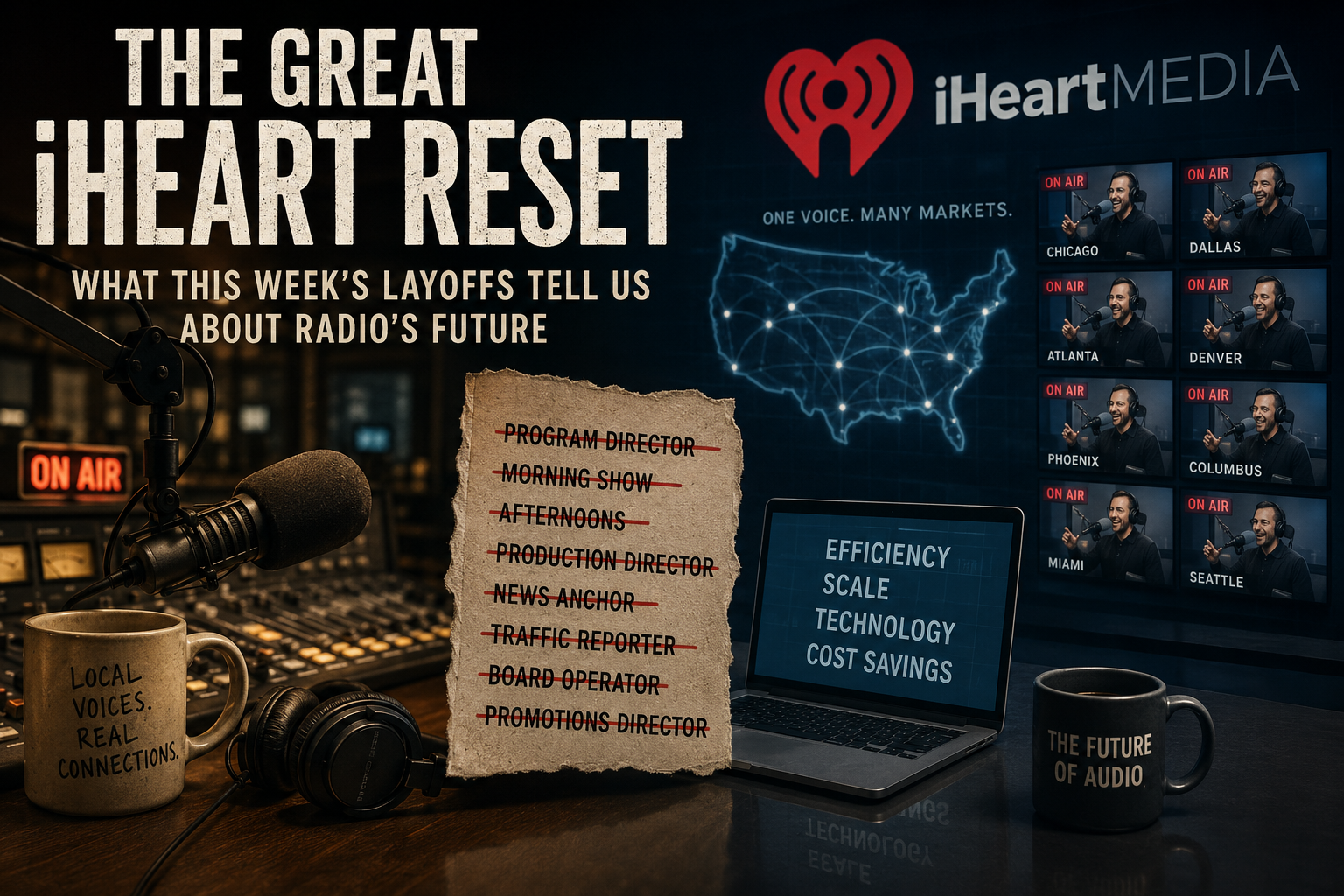
iHeartMedia announced a programming realignment that touched stations across the country. The company described the plan as a step toward faster operations and better use of technology. The announcement came with another round of layoffs. Program directors, morning hosts, production staff, and longtime air personalities lost their jobs in markets large and small.
Anyone who has worked in radio long enough has seen this story before.
A memo arrives.
Corporate leaders explain a new strategy.
Employees thank listeners on social media.
Another chapter closes.
This round feels different.
The cuts reached nearly every format. Country, Rock, News/Talk, CHR, Adult Contemporary, Classic Hits, and Alternative stations all lost people. Some employees had worked for their stations for more than two decades. Others had accepted new jobs, bought homes, and started fresh careers.
The names change. The pattern stays the same.
The Memo Says More Than It Appears
Corporate memos rarely tell the whole story. They tell readers what leadership wants them to hear.
This memo focused on technology, speed, precision, and new capabilities. It promised stronger support for local communities. It promised a better product for listeners. It promised a stronger future for the company.
Read those statements from another angle.
Technology allows one programmer to oversee several stations.
One personality can voice track shows for markets hundreds of miles apart.
One production team can create imaging for dozens of stations.
Those ideas save money. Public companies pay close attention to costs. Investors expect growth. Expenses receive constant review.
That reality shapes every decision.
“Guaranteed Human”
One sentence in the memo deserves attention.
iHeart said “Guaranteed Human” remains at the center of its strategy.
Radio has always depended on people.
The morning host who knows every school closing.
The afternoon personality who talks about traffic across town.
The program director who spends Saturday at a charity event.
The production director who gives a station its sound.
Those jobs create local trust. They build habits. They give stations a voice that listeners recognize.
The timing of the announcement creates an obvious contrast.
The company praised human talent on the same day many human voices disappeared from local stations.
That contrast deserves discussion.
This Is Bigger Than One Company
The radio industry has changed for years.
Ownership became more concentrated.
Voice tracking spread across the country.
Programming moved into regional hubs.
National talent filled more dayparts.
Production became centralized.
Cloud systems replaced local studios for many tasks.
None of those changes happened in one year.
Each step reduced the number of people needed to operate a station.
Technology did not create this trend.
Technology sped it up.
The Business Side Cannot Be Ignored
Emotion tells one part of this story.
Money tells the other.
Earlier this year, iHeartMedia announced another $50 million in planned cost reductions for the second half of 2026. Those cuts came after about $100 million in savings already planned or completed during the year.
Those numbers explain the pressure facing management.
Radio competes for advertising against search, social media, streaming audio, connected television, podcasts, and dozens of digital platforms.
Every dollar matters.
Every position faces review.
That does not make layoffs easier.
It explains why they continue.
The Risk for Radio
Radio still owns one advantage that streaming services cannot duplicate.
Local connection.
A playlist cannot cover a tornado warning.
An algorithm cannot interview the high school football coach after a championship game.
A music app cannot spend three days raising money after a community loses homes to a fire.
Those moments create loyalty.
People remember stations that show up during the best days and the hardest days.
That value does not appear on a spreadsheet.
It exists in the relationship between a station and its audience.
Lose that relationship and radio becomes another audio service competing for the next song.
What Comes Next?
This week did not mark the end of local radio.
It marked another step in a long transition.
Technology will continue to reshape station operations.
Artificial intelligence will enter more production rooms.
Regional programming will expand.
Shared talent will appear on more stations.
Those changes are already here.
The real question has nothing to do with software.
How much local identity can disappear before listeners stop hearing a reason to choose radio?
Every broadcaster should think about that question.
Every owner should think about it.
Every programmer should think about it.
The answer will shape the next decade of American radio.