

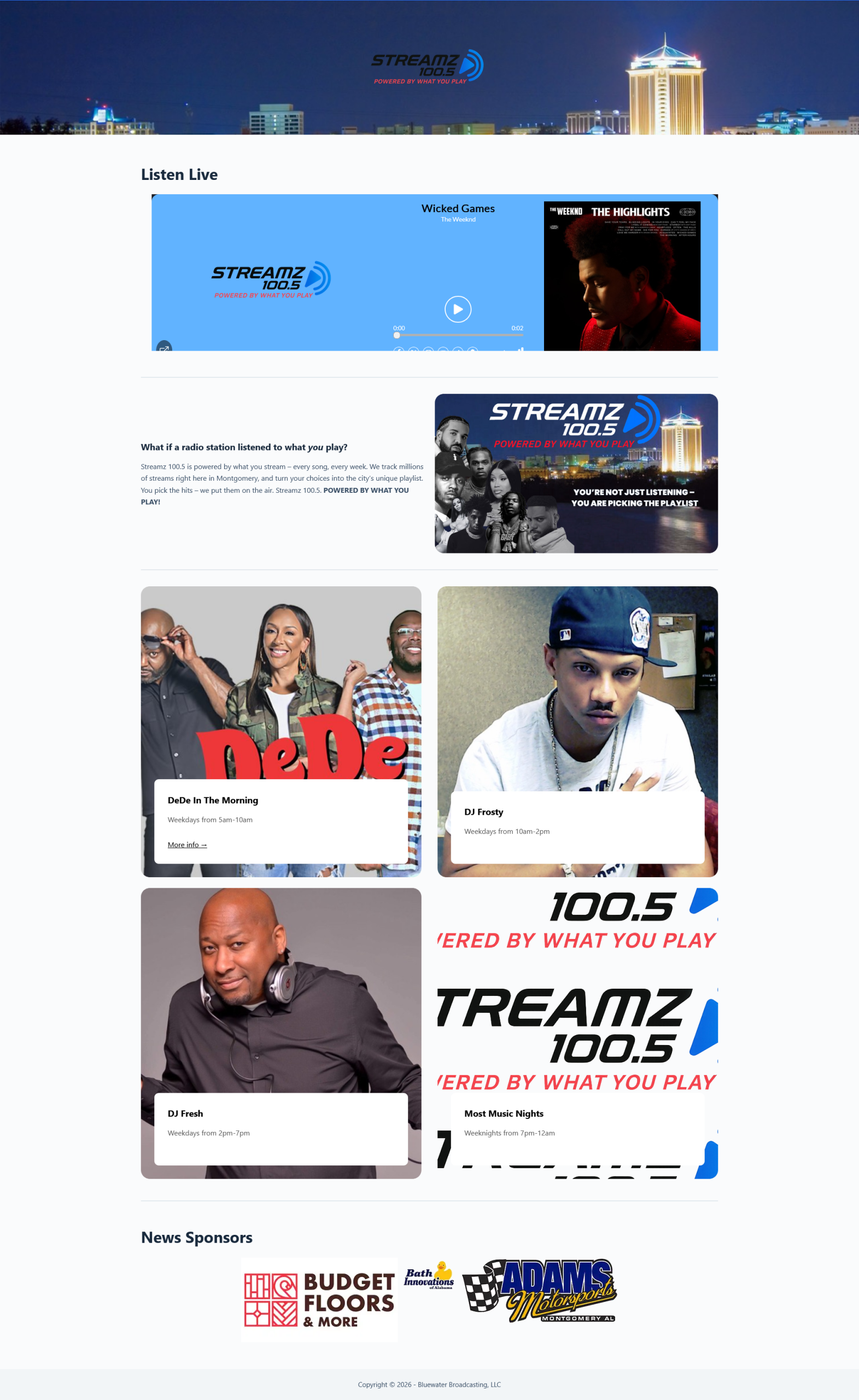
Streamz 100.5 sells streaming activity as listener control. Its post-launch ratings give the hype something to answer for.
A radio station should give people a reason to listen.
That is why the pitch behind Montgomery’s Streamz 100.5 leaves me scratching my head. Your listening somewhere else helps determine what this station plays. Then, presumably, you come back to hear the results.
That sounds like a better advertisement for streaming than for the radio station.
In its December 2025 launch coverage, Radio Ink reported that Bluewater Broadcasting’s Hip-Hop and Contemporary R&B station uses local streaming activity to guide its playlist. Program Director DJ Fresh said the station analyzes more than three million weekly streams across 19 services through Bridge Ratings.
“Your stream is your vote,” he said.
Catchy slogan. Now explain what the listener actually controls.
I own and program XLoungeRadio.com, so I am looking at this as another operator. Audience research has value. Knowing what people enjoy should help you build a better station.
But studying an audience does not automatically put that audience in charge.
Someone playing a song on a streaming service is choosing music for themselves. They may have no idea that their activity could influence a radio playlist. Calling that a vote stretches the meaning of participation.
How much streaming activity gets a song added? How are repeat plays handled? What happens when a popular song falls outside the format?
The launch article does not explain those rules.
That is where the listener-control pitch loses me. You want credit for handing over the programmer’s chair, but the listener cannot see what the controls do.
To me, that is the hypocrisy in the sales pitch. You cannot celebrate giving people power without explaining how much power they have.
The article does not require anyone to spend hours streaming before getting a song played. The contradiction is in the selling point itself: activity outside the station supposedly makes the station worth choosing.
If I already have somewhere to hear what I want, you still need to explain why I should come back.
That is why this reads to me like a publicity gimmick built around a useful research tool. The research may be sound. The promise attached to it deserves scrutiny.
The ratings give that scrutiny some weight.
The captured RadioInsight Montgomery ratings table shows the following results for WQKS-FM HD2, the feed carrying Streamz 100.5:
Fall 2024 1.3
Spring 2025 0.9
Fall 2025 1.3
Spring 2026 0.6
Across the two 2025 surveys, the service recovered from 0.9 to 1.3. After the December launch, its Spring 2026 result came in at 0.6.
The earlier recovery was gone. The latest figure was the lowest of the four shown.
That is a decline of 0.7 points, roughly 54 percent from the Fall 2025 figure. It does not mean 54 percent of individual listeners left.
The chronology also matters. That earlier recovery preceded the Streamz launch. These numbers show a lower result after the rebrand, not an initial Streamz surge followed by a collapse.
One survey cannot tell us why the number fell or prove the format has failed. It certainly does not give this launch pitch a victory lap.
Three million streams look impressive in an announcement. The station still has to earn listening of its own.
From the PD’s chair, that is the part I care about. What happens when somebody tunes in? Does the music flow? Is there a reason to stay? Does the station offer something worth returning to?
Those questions require programming judgment.
A list of popular songs gives you information. Building a station takes decisions about pacing, repetition, discovery, and personality. Somebody still has to make those decisions and answer for the result.
If Streamz wants to sell listener control, show how that control works. Explain how streaming activity becomes airplay. Give people something they can understand and evaluate.
Until then, I see a research method carrying a much bigger marketing promise.
Radio does not earn relevance by borrowing the language of streaming. It earns relevance by making people want to listen.
If your strongest selling point is what your audience does somewhere else, you still have work to do.